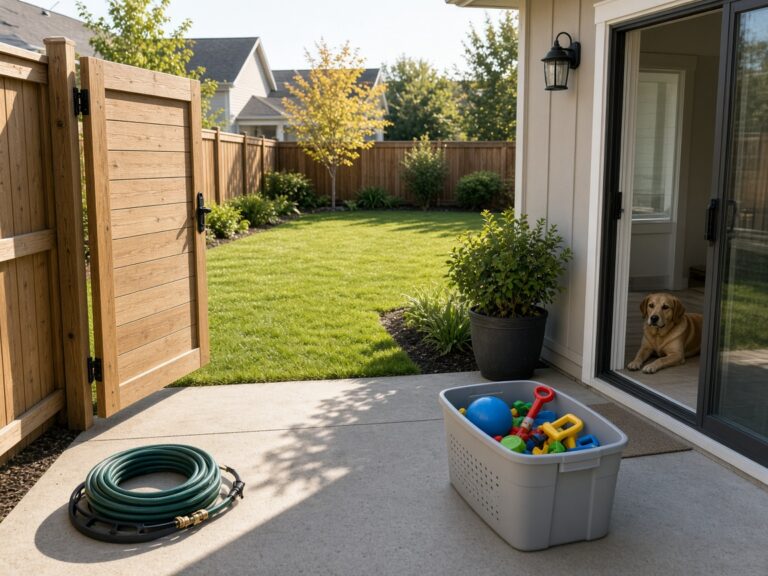
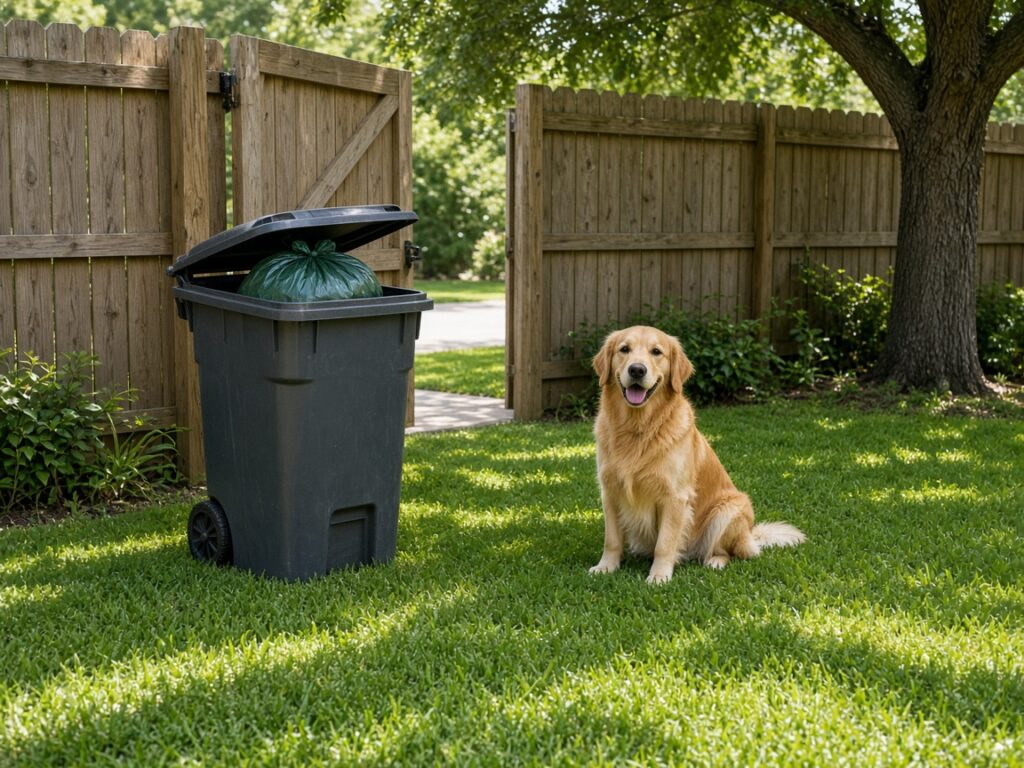
After every visit, the pet waste we collect goes into a bag, and that bag goes into your household trash cart — not into our vehicle. Customers reasonably ask why we don’t just take it with us. The honest answer involves how cities and the State of Texas regulate the collection and transportation of other people’s waste. This article explains what we do today, what the rules we reviewed actually say, where they are unclear, and what would need to happen before we could offer haul-away.
Last reviewed: September 30, 2026. The legal and regulatory sources below were reviewed on that date. Rules change, so check the linked official sources for current versions.
What We Do Today
Here is what happens to the waste during a residential visit from Heather’s Poop Scoop Service:
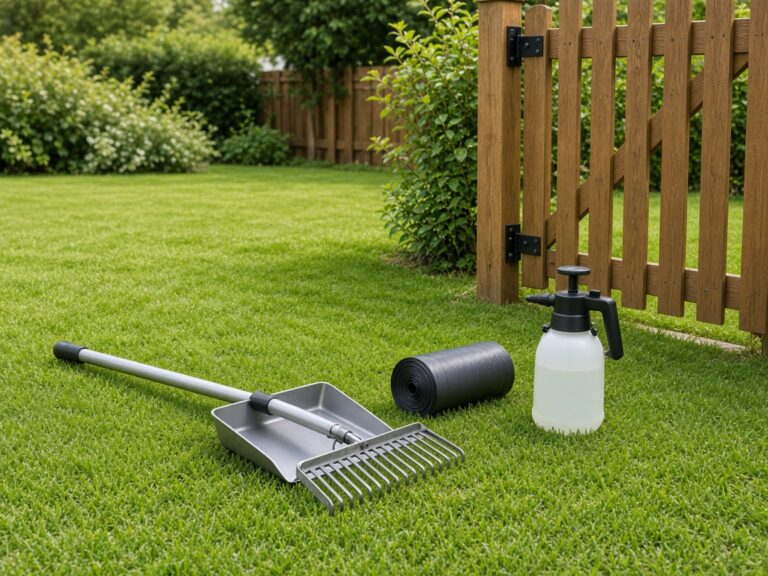
- We walk the yard and collect the pet waste we find.
- The waste is bagged.
- The bagged waste is placed in your designated household trash receptacle — usually your rolling trash cart.
- We apply the free yard deodorizer that comes with every service.
- Your regular trash service picks up the cart on its normal schedule, just like the rest of your household trash.
Each cleaning includes the first two bags, and each additional bag is $5. Your trash cart needs to be reachable during the visit. If it usually sits somewhere we can’t reach, tell us when you request service so we can sort it out before the first visit.
Why Customers Ask About Haul-Away
It’s a fair question. The cart can get smelly in summer, some carts fill up before trash day, and “take it with you” sounds like the most complete service. Some people also assume a professional company can drop waste off somewhere a homeowner can’t. The trouble is that once a business starts collecting and transporting waste for a fee, it can become a regulated waste hauler. What that requires depends on where the waste comes from, what kind of property it is, and which city or county you’re in.
The Short Answer
We did not find any Houston or Texas rule saying “it is illegal to haul dog poop.” What we found is a set of rules about who may collect and transport solid waste. Some of them clearly apply to commercial hauling. Others, like some suburban city codes, limit collection to the city’s contractor. And for a pet-waste company hauling from single-family homes, several points are simply unclear. Putting bagged waste in the customer’s own trash cart avoids those unresolved questions, and it is a disposal method Houston’s code specifically anticipates.
What Houston’s Code Says (Inside City Limits)
Bagged pet waste in household containers is expressly addressed
Chapter 39 of the Houston Code of Ordinances governs solid waste. Section 39-61 lists conditions under which a container may not be set out for collection by city or private collectors. One of them is a container that “contains pet feces, unless such feces are wrapped separately and securely to avoid spillage, and placed so that its odor is not offensive to collection crews or the general public.” In other words, the code expects bagged pet waste to go into household trash containers, as long as it’s wrapped securely.
Commercial hauling requires a franchise
Article VII of Chapter 39 defines a “commercial solid waste operator” as any person who collects, hauls, or transports solid waste for a fee, by any means. Section 39-113 makes it unlawful for a commercial solid waste operator to collect, haul, or transport solid waste from commercial properties in the city without first getting a franchise approved by City Council. The City’s Administration & Regulatory Affairs Department (ARA) runs the franchise program. Franchisees pay a fee based on gross revenue and must meet application and insurance requirements.
The code defines “commercial properties” as commercial and industrial land, excluding apartment and condominium complexes and single-family homes. ARA’s franchisee reporting form likewise treats receipts from residential properties as exempt from the franchise fee.
Where it gets unclear for residential yards
So the franchise requirement doesn’t reach single-family homes. That does not automatically mean residential hauling is unregulated. In the sections we reviewed, we did not find a provision that specifically addresses a pet-waste service collecting waste at a house and hauling it away. Other parts of Chapter 39 still apply to anyone moving solid waste. For example, Section 39-96 requires vehicles mainly used to transport solid waste to display the hauler’s name and phone number. We consider the residential question unresolved and would want written confirmation from the City before relying on any interpretation.
What Texas Rules Say
Texas groups most everyday trash under “municipal solid waste.” The TCEQ’s municipal solid waste rules (30 Texas Administrative Code § 330.3) define several terms that matter here:
- Household waste is solid waste from single and multiple residences.
- Commercial solid waste is waste from stores, offices, restaurants, warehouses, and other nonmanufacturing activities, excluding residential and industrial waste.
- A transporter is “a person that collects, conveys, or transports solid waste; does not include a person transporting his or her household waste.”
That last definition captures the key distinction. A homeowner hauling their own trash to a facility is not a “transporter” under the rule. A business that collects and moves other people’s waste fits the general definition.
At the state level, the TCEQ’s guide Transporting Waste in Texas (RG-86) says the agency generally does not regulate the transportation of municipal solid waste to Type I landfills. The exceptions it lists include medical waste, used oil and filters, waste tires, and sludge. The Texas Health and Safety Code, however, lets local governments adopt their own rules for solid waste “collection, handling, transportation, storage, processing, and disposal” (§ 363.111). Counties can regulate collection and disposal in unincorporated areas outside city limits and city extraterritorial jurisdictions (§ 364.011). So for ordinary household waste, most practical requirements come from local rules, not a state permit.
There’s also the question of where hauled waste would go. What each Texas disposal facility may accept depends on its own TCEQ authorization. A hauler would need to confirm, facility by facility, that the site accepts the material from a commercial operator.
Surrounding Communities Are Not the Same as Houston
Our service area covers Northwest Houston and surrounding communities, and those communities don’t all follow Houston’s rules.
- Tomball is an example of a city that limits collection to its contractor. Its solid-waste chapter (Chapter 36, adopted by Ordinance 2019-23) says that, apart from limited exceptions, only the City’s authorized contractor or city employees may collect or transport solid waste on city streets without prior approval. Private collection requires written permission from City Council.
- Unincorporated Harris County neighborhoods often get trash service through a municipal utility district (MUD) or HOA contract with a private hauler. The rules, carts, and accepted materials vary by district.
- Other cities set their own solid-waste ordinances and contracts. We don’t assume any two are identical.
What We Know — and What We Don’t Want to Misrepresent
Waste rules are easy to oversimplify, so here is how we think about the pieces:
- Generation: your dogs produce waste on your property, which makes it household waste from your home.
- Collection: gathering waste from where it sits. Picking it up in your yard and bagging it is what we do.
- Transportation: moving waste off the property, especially for a fee and on public streets. This is where hauler rules, franchises, and exclusive contracts come into play.
- Disposal: where the waste ends up, such as a landfill or other authorized facility. That is controlled by facility authorizations.
- Residential vs. commercial: Houston’s franchise applies to commercial properties. Residential properties are treated differently, and the rules for residential hauling by a service company are less clear.
- Municipal vs. state: the state defines the terms and regulates certain wastes. Cities and counties set most local collection and hauling rules.
What we know: Houston requires a City Council-approved franchise to haul solid waste for a fee from commercial properties. Some nearby cities limit collection to an authorized contractor. And Houston’s code expressly expects securely wrapped pet waste to go into household containers.
What we are not claiming: We are not saying hauling dog waste is illegal in Houston. We did not find a rule written specifically for pet-waste services. We have not determined exactly what authorization, if any, would apply to hauling waste from single-family homes inside Houston city limits. And we make no claims about how other companies operate. They may hold authorizations, serve different areas, or have arrangements we know nothing about.
Why the Trash Cart Is the Right Choice for Now
This isn’t just a preference. Putting bagged waste in the customer’s own trash receptacle:
- keeps the waste in the household trash stream it came from, collected by the service your home already has;
- uses a disposal method Houston’s code specifically describes for pet feces;
- avoids operating as a waste hauler in places where hauling may require a franchise, permit, or city approval; and
- works the same way everywhere we serve, instead of changing rules from street to street.
What Would Need to Change Before We Offered Haul-Away
Before offering haul-away anywhere, we would need to:
- Get written guidance from each city or district involved, starting with the City of Houston, on whether hauling from residential yards requires authorization.
- Get any franchise, permit, or council approval required. That includes a Houston franchise for any commercial-property hauling inside city limits.
- Find an authorized disposal facility that will accept the material from a commercial operator.
- Meet any vehicle, insurance, and record-keeping requirements that apply.
- Update our pricing, service terms, and this article so customers know exactly what changed.
If the rules or our answers change, we’ll update this page and the review date at the top.
A Few Trash-Cart Tips
- Keep the lid closed. Houston’s code also requires containers that keep contents and pests in.
- Leave room in the cart before scoop day if you can, especially if you have several dogs.
- Follow your own hauler’s cart rules, such as weight limits and set-out times.
- Rinse the cart now and then during hot months to help with odor.
This article is provided for general informational purposes and is not legal advice. Waste-management requirements can change, and specific situations may depend on the property, municipality, waste classification, and applicable permits or authorizations.
Questions About How We Handle Waste?
We’re happy to walk you through a visit before you book. You can also read what happens during a professional poop scoop service or check our frequently asked questions.
Sources & Further Reading
- City of Houston Code of Ordinances, Chapter 39 — Solid Waste and Litter Control (Secs. 39-61, 39-96, and Article VII, including Secs. 39-111 and 39-113)
- City of Houston ARA — Solid Waste Franchises
- City of Houston ARA — Solid Waste Operator Franchisee Quarterly Report (residential exemption note)
- 30 Texas Administrative Code § 330.3 — Definitions (municipal solid waste)
- TCEQ RG-86 — Transporting Waste in Texas
- TCEQ — Types of MSW Facilities and Wastes That May Be Accepted
- Texas Health and Safety Code, Chapter 363 (§ 363.111)
- Texas Health and Safety Code, Chapter 364 (§ 364.011)
- City of Tomball Ordinance No. 2019-23 — Chapter 36, Solid Waste